
Richard Hanania on Prediction Markets, MAGA, and What Comes After Trump
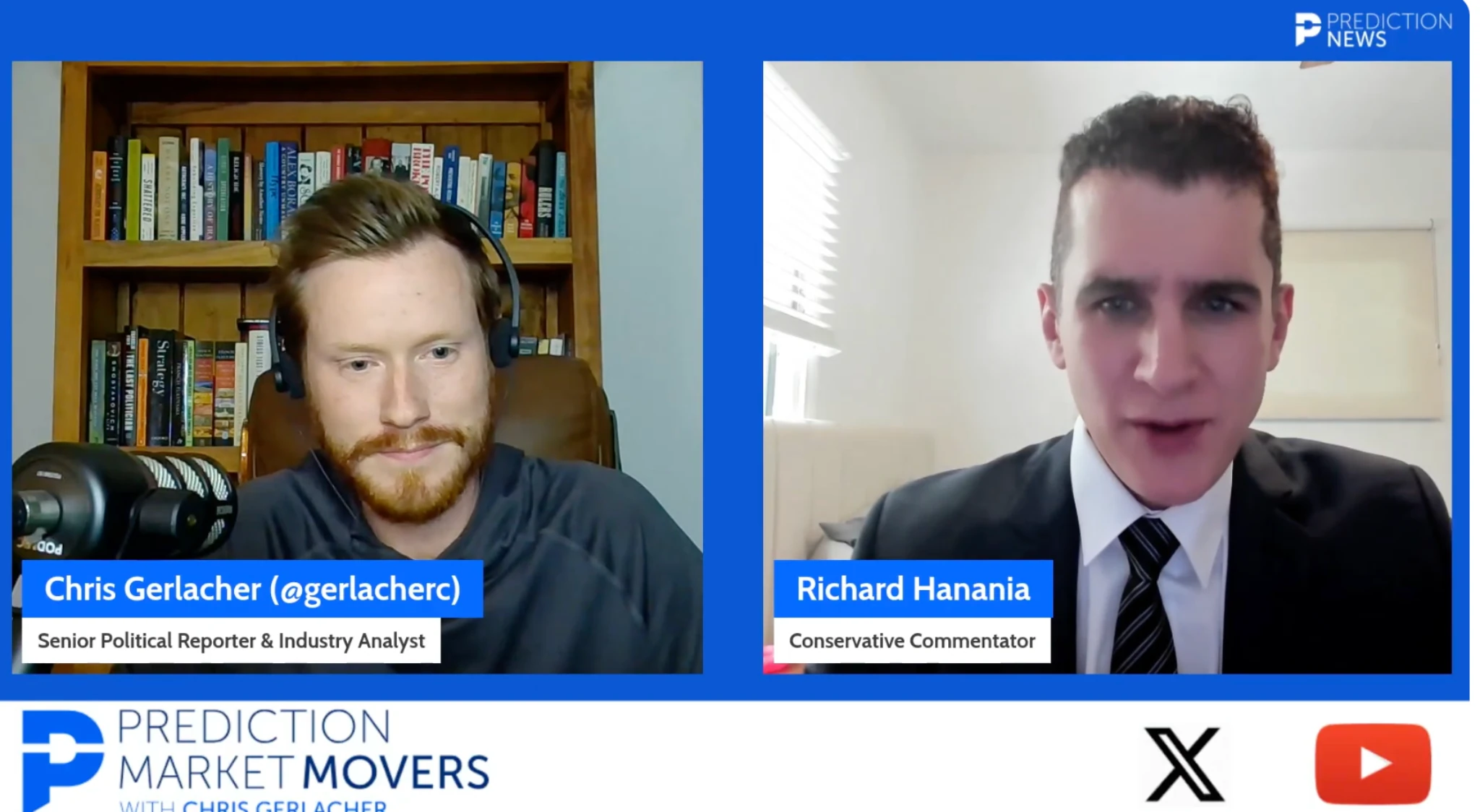
Richard Hanania is one of the best-placed critics of the Trump administration and Republican Party leaders. A former white nationalist and Project 2025 contributor, Hanania publicly renounced the MAGA movement shortly after Trump took office in 2025.
He was also a named plaintiff in PredictIt’s case against the federal government. PredictIt reached a settlement with the CFTC in 2025 after a three-year battle over its no-action letter. Hanania believed in the value of prediction markets and objected to the federal government’s attempt to ban what was then the only real-money prediction market for elections regulated in the United States
Hanania stopped by Prediction Market Movers to discuss his use of prediction markets, white nationalism in the Republican Party, and his thoughts on post-Trump Republican leadership.
Hanania’s prediction market trades
Hanania became a PredictIt trader in 2018 and has since traded on Kalshi and Polymarket. He isn’t trading nearly as much in 2026. Larger administration stories keep him from more niche markets. However, he has been paying close attention to the Ohio gubernatorial election.
“At one point, Casey Putsch, my God, was like a 30% or 25% for a few days during Christmas,” Hanania said. “And I don’t think there’s ever been a poll showing him getting one or two percent…He’s in his garage asking AI about Hitler and why Hitler wasn’t bad. I mean, this guy’s really out of his mind.”
Putsch has a YouTube channel, Casey the Car Guy. One of these videos is titled “AI outs Christians as naive on ISRAEL (lists Adolf Hitler’s GOOD qualities).” Hanania believes Vivek Ramaswamy is a lock for the primary in the Ohio governor’s race. That belief has led to some apparently safe trades on Putsch’s low chances.
“I didn’t get [it] at the highest price, but I did get a bunch of no’s at like, 80 or 85 cents,” Hanania said. “And I’ve been trying to goad his followers into putting more money down, so I can get more money there.”
Putsch’s candidacy is emblematic of a larger problem within the Republican Party: a contingent of white nationalists that even Vice President J.D. Vance won’t criticize.
White nationalism in the Republican ranks
It may sound hyperbolic to claim that white nationalism is a problem in Republican politics. However, Hanania argues that Vance’s capitulation to that faction shows how influential it has become.
“They attack his [Vance’s] wife, and he’s scared to death to criticize these people. They get that this is kind of where, I don’t say the base, like the Republican voter [is], but like the people who show up to ask questions at college events or the people who comment on the internet…the most mobilized 10% or something.”
These voters are driven by the popularity of internet figures like Nick Fuentes. Fuentes is a white nationalist streamer who has called non-white Republican candidates “anchor babies.” He has even encouraged Republican voters to sit out of the Ohio gubernatorial race to “punish the GOP” for running a non-white candidate.
Even a likely challenger to Vance is cozying up to Fuentes and his supporters.
“The person who might attack Vance from the populist right, who’s apparently going to run, is Steve Bannon, who’s going to say ‘You’re too friendly to immigrants. You’re too friendly to foreigners. You are too close to these tech guys.’”
Bannon is the original architect of the MAGA movement. He has called for Trump to run for an unconstitutional third term. Bannon, a conspiracist himself, could ally himself with the white nationalists to mount a challenge in 2027.
“One of his [Bannon’s] people who is involved with his media outlet, I don’t know, one of the hosts or something is often boosting Fuentes and responding to him on Twitter,” Hanania said. “So they’re doing this little dance. And so that’s at least going to make some noise, probably going to make Vance a little bit uncomfortable.”
’26 Midterms and ’28 Presidential Predictions
Republican’s chances of keeping the House of Representatives in 2026 are slim, though they remain competitive in the Senate. However, the future of Republican Party leadership will be up in the air after the midterms.
Trump’s exit combined with an open Democratic presidential primary could chart a new future for both parties or give them room to regress. For all his experience on prediction market platforms and forecasting Trump’s elections, Hanania doesn’t know where the Republican Party will go after Trump.
“This is not like something I feel comfortable predicting, despite the theme of this podcast, just because it’s like taking the sun out of the solar system. Everything is just going to become scrambled. And…we’ll be watching. That’s all we can do.”