
Coinbase Adding Kalshi Prediction Markets, Stock Trading
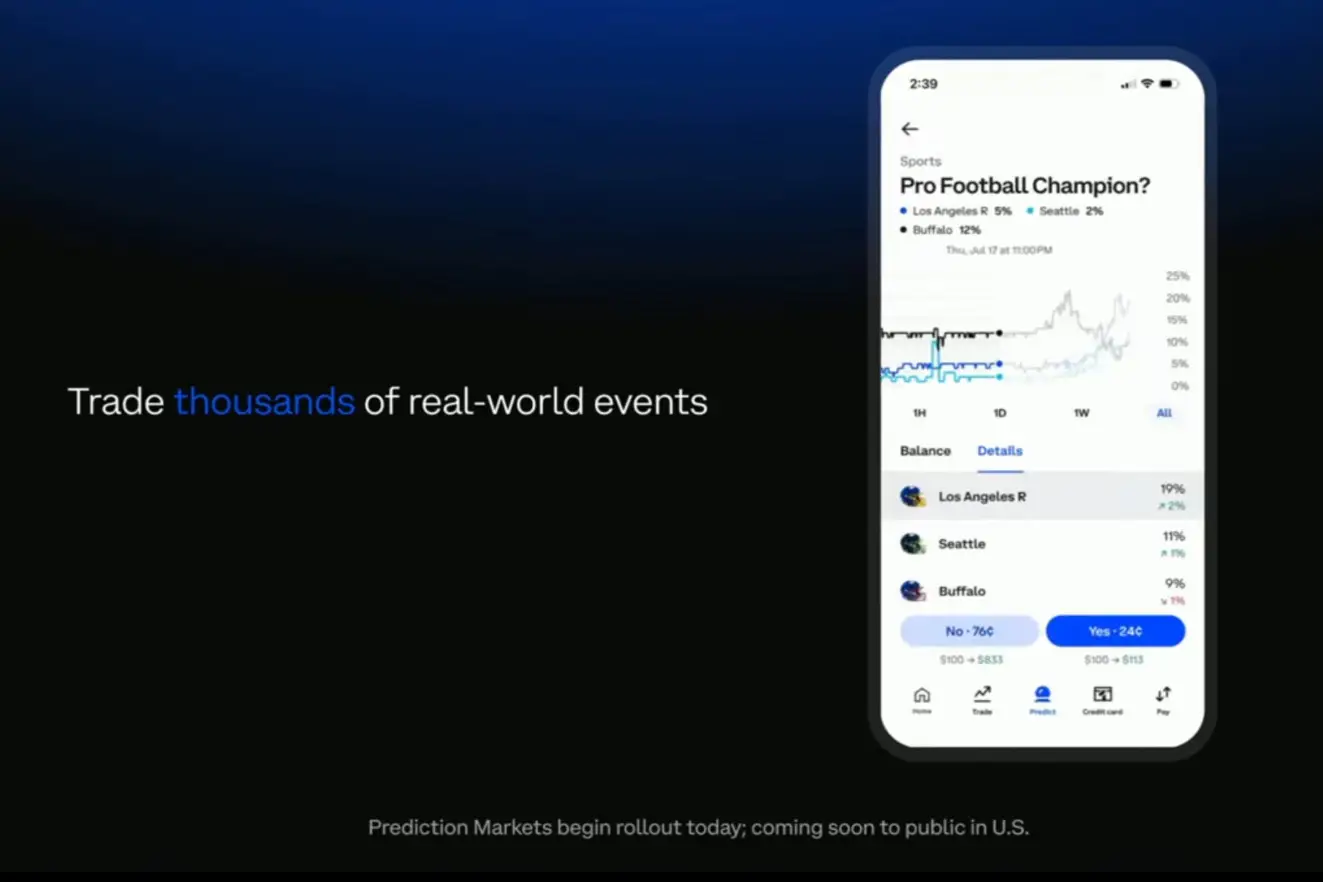
Coinbase, the largest US-based crypto exchange by trading volume, has officially announced that it will be offering prediction markets on its platform. The markets will be powered by Kalshi, the prediction market powerhouse that is currently battling Polymarket for global market supremacy.
Coinbase announced its prediction market additions today during its System Update livestream event. The company also announced it will begin offering tokenized stock trading, equity perpetuals, more tools for businesses, and much more.
“On the everything exchange, you’ll be able to trade anything, anytime, anywhere,” Max Branzburg, vice president of product at Coinbase, said during the presentation, as images of the new predictions tab were shown. “And it’s not just crypto predictions. You can now participate in markets on everything happening in the world. You can see a ton of different categories, from sports to crypto to entertainment.”
You’ve got hot takes – now you’ll have a place to trade them.
Here’s a first look at Prediction Markets on Coinbase ↓ pic.twitter.com/89VmttCRI0
— Coinbase 🛡️ (@coinbase) December 17, 2025
Coinbase prediction markets begin rolling out today
The rollout of prediction markets on Coinbase begins today (Wednesday) for select users and they will be available to all US users soon, the company said.
“As you can see, buying a contract is just as easy as buying Bitcoin,” Branzburg continued. “If you follow the news, you can trade on election outcomes, policy decisions or economic performance. … Prediction markets enable increased access to information and markets that have historically not existed. And they’re now available directly in the Coinbase app.”
Coinbase Financial Markets, Inc., a Coinbase subsidiary, is approved as a Futures Commission Merchant (FCM) with the Commodity Futures Trading Commission (CFTC). The designation allows Coinbase to partner with CFTC-approved Designated Contract Markets (DCM) like Kalshi to offer regulated prediction markets on its platform.
A source told CNBC last week that Kalshi will be the sole prediction market facilitator for Coinbase initially, but the partnership is not exclusive, meaning the company could partner with other DCMs in the future.
Coinbase partners with Kalshi to launch prediction markets.
The most trusted name in crypto integrates the world’s leading prediction market.
Millions more will have access to Kalshi. pic.twitter.com/k4XfFRh3zm
— Kalshi (@Kalshi) December 17, 2025
Coinbase hasn’t been shy about its prediction market intentions
Coinbase’s intention to enter the prediction market space hasn’t exactly been a secret. Shortly after the company’s July “A New Day One” event announcing expansion of its Base App crypto wallet dropped hints about possible prediction market integration, Branzburg confirmed to CNBC that event contract trading would be a part of the “everything app.”
In November, digital detective Jane Manchun Wong discovered non-public Coinbase pages that showed a “Predictions” hub with markets powered by Kalshi. Sources confirmed the plans to The Information the following day.
Earlier this month, Coinbase was announced as a founding member of the Coalition for Prediction Markets, a new national advocacy and lobbying group. Coinbase is joined in the Coalition by top prediction market providers like Kalshi and Crypto.com, as well as top competitor Robinhood, a leading retail brokerage that also carries prediction markets powered by Kalshi (for now) on its platform.
With the Trump administration’s more favorable approach to crypto and prediction markets, Coinbase has also been expanding its ties to the government. The company (alongside Robinhood) was announced as an initial member of the United States Tech Force, a new recruitment program announced this month that seeks to “(unleash) private sector innovation while also recognizing the federal government must have the technical talent to lead in technology modernization.” The partnering tech firms will reportedly lend workers to assist with technology upgrades and training.
Kalshi partnership should greatly benefit both companies
Coinbase’s partnership with Kalshi is a win-win for both entities. Crypto users are more engaged with prediction markets than non-token holders, so it’s wise to make access to them as frictionless as possible, something the alliance makes possible.
Japanese investment banking and securities firm Mizuho recently conducted a survey of Coinbase and Robinhood users and found that they were nine times more likely to engage with prediction markets than people who don’t use the apps. But Mizuho did warn of “potential cannibalization from crypto sales” at Coinbase with the introduction of event contract trading, as just 37% of respondents said they were planning to fund event contract trades with new deposits.
The partnership helps Kalshi further ingratiate itself within the crypto community, putting its markets directly in front of Coinbase’s 100 million-plus users. That has the potential to greatly boost Kalshi’s market liquidity and overall trading volume, which has reached peak levels over the past couple of months.
Robinhood, which announced plans to expand its prediction market offerings at a livestreamed event last night, accounts for a large chunk of Kalshi’s trading volume with its integrated markets. While the precise amount is unknown, analysts, like those at Piper Sandler, estimated in September that 25%-35% of Kalshi’s overall trading volume was coming from Robinhood, and that was prior to the noticeable volume boost from NFL markets. Other reports have suggested Kalshi could be receiving more than 50% of its trading volume from Robinhood users.
Liquidity no issue for Kalshi
While still offering Kalshi markets currently, Robinhood announced in November that it had partnered with Susquehanna International Group to purchase a majority stake in MIAX Derivatives Exchange, which is CFTC-approved as both a DCM and Derivatives Clearing Organization (DCO). That will allow Robinhood to operate its own full-service prediction market exchange in-house, and likely become less reliant on Kalshi.
Kalshi could fill in some of the volume gaps likely to arise from even a partial Robinhood exit through its partnerships with crypto exchanges like Coinbase, as well as other crypto-native companies, like the Phantom wallet, which announced last week that it would provide access to Kalshi markets for its more than 20 million users directly on its platform.